Instrument currency explained (66 HIT, the 6-month rule)
Updated September 14, 2026
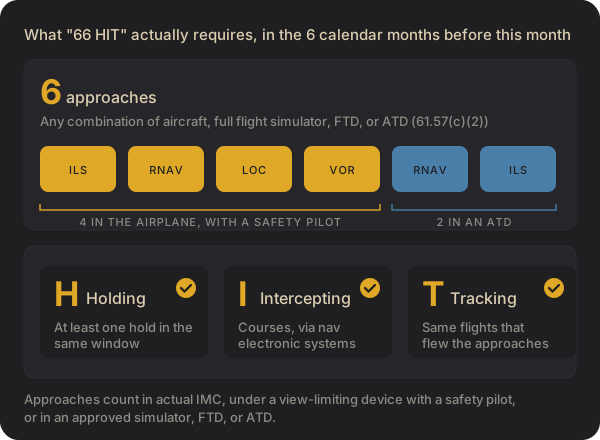
Short answer: to act as PIC under IFR or in weather conditions below the minimums prescribed for VFR, 14 CFR 61.57(c) (official current text) requires that within the 6 calendar months preceding the month of the flight you have performed and logged, in actual weather conditions or under simulated conditions using a view-limiting device:
- 6 instrument approaches
- Holding procedures and tasks
- Intercepting and tracking courses through the use of navigational electronic systems
Pilots remember it as "66 HIT": 6 approaches in 6 months, plus Holding, Intercepting, and Tracking.
Two things worth knowing up front. The requirement is tied to the category of aircraft for the instrument rating privileges you want to maintain (airplane, powered-lift, helicopter, or airship), so currency in one category does not carry over to another. And 61.57(c) opens with "Except as provided in paragraph (e)," which carves out certain operations, so check paragraph (e) if you fly under a rule that might exempt you.
What "6 calendar months" actually means
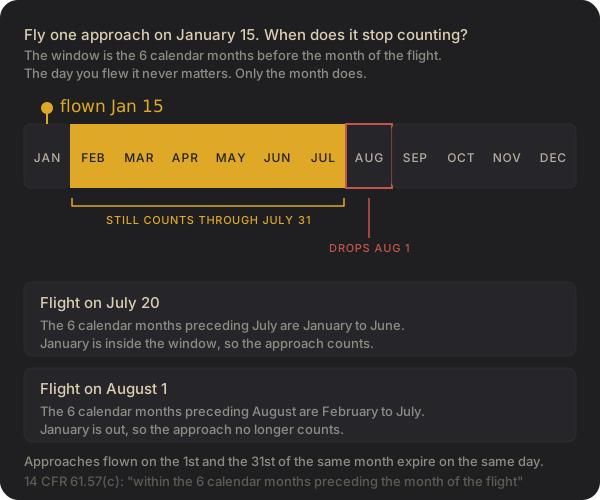
This is the part that trips people up, and the regulation is more generous than most pilots assume. The window is not six months counted back from today. It is the 6 calendar months preceding the month of the flight, which means a qualifying task counts through the end of the sixth month after the one you flew it in.
Fly an approach on January 15 and it stays valid for every flight through July 31. For a flight in July, the six calendar months preceding July are January through June, so January still counts. On August 1 that approach drops out, because the six calendar months preceding August are February through July.
The practical effect: the day of the month you flew the approach never matters. Only the month does.
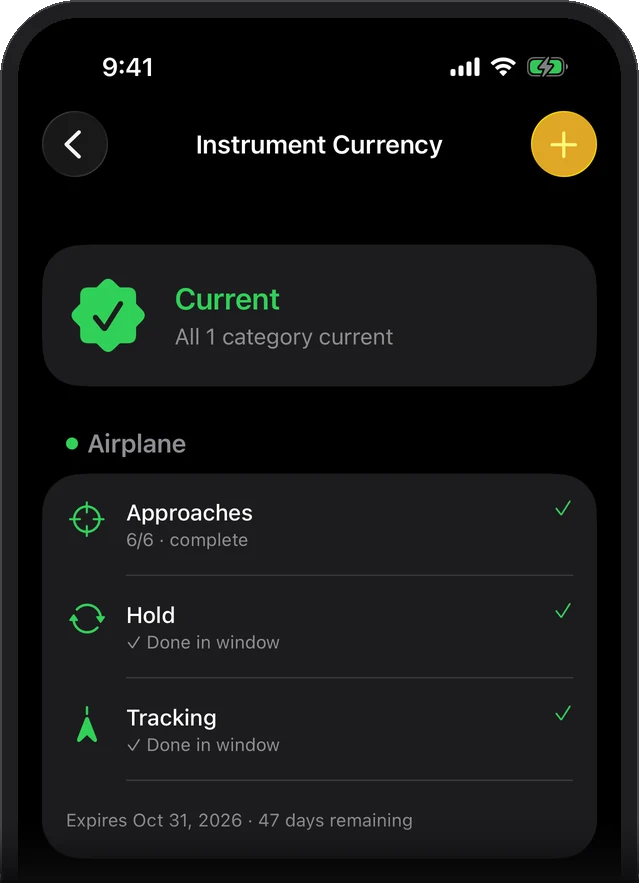
KármánLogs does the calendar-month math for you. Every approach, hold, and tracking task you log feeds the Instrument Currency screen above: the exact date your currency expires, how many approaches you still need, and whether you are in the grace period or past the point where an IPC is required. Log an approach with one tap and the countdown updates. More on how it works at the end of this guide, or get KármánLogs on the App Store.
Where you can do it
In an aircraft. In actual instrument conditions, or in simulated conditions with a view-limiting device and a safety pilot.
In a simulator or training device. Under 61.57(c)(2), you may accomplish the same requirements in a full flight simulator, flight training device, or aviation training device, provided the device represents the category of aircraft for the instrument rating privileges being maintained and you perform the tasks in simulated instrument conditions.
In any combination. This is the part pilots most often miss: 61.57(c)(2) expressly permits completing the instrument experience "in any combination of an aircraft, full flight simulator, flight training device, or aviation training device." Four approaches in the airplane and two in an ATD is fine.
If you use a safety pilot, 14 CFR 91.109(c) requires that they occupy the other control seat, hold at least a private pilot certificate with category and class ratings appropriate to the aircraft being flown, and have adequate vision forward and to each side (or a competent observer supplements it). The aircraft must have fully functioning dual controls, with a narrow exception for a single-engine airplane fitted with a single throwover control wheel.
Who logs PIC on a safety pilot flight is a separate question with its own rules: see logging PIC time explained.
Gliders have their own instrument currency requirements under 61.57(c)(3), stated in flight hours rather than approaches. If you fly gliders IFR, read that paragraph directly.
What happens when you lapse
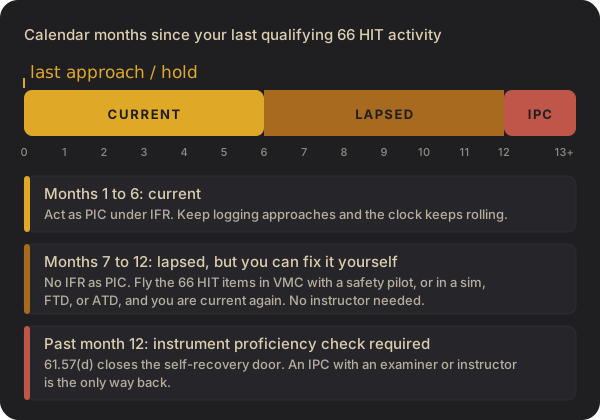
| Since your last qualifying activity | Current? | What it takes to fix |
|---|---|---|
| Months 1 to 6 | Yes | Nothing. Fly IFR normally. |
| Months 7 to 12 | No | Regain it yourself by completing the 66 HIT items, in VMC with a safety pilot or in a simulator, FTD, or ATD. |
| Past 12 months | No | An instrument proficiency check. You can no longer regain currency on your own. |
In the months 7 to 12 window you are not current and may not act as PIC under IFR, but nothing stops you from going out and doing the 66 HIT items to get back. Once you have failed to meet the 61.57(c) requirements for more than six calendar months, 61.57(d) closes that door and an IPC becomes the only way back.
What is on an instrument proficiency check
Under 61.57(d)(1), an IPC must include the areas of operation contained in the applicable Airman Certification Standards, as listed in appendix A of part 61, appropriate to the rating you hold. It is not a fixed checklist of approaches; it is the full ACS instrument task set as the evaluator elects to cover it.
Where it can be done (61.57(d)(2)): in an aircraft appropriate to the aircraft category, or, for anything other than a glider, in a full flight simulator or flight training device representative of that category. Note the difference from currency: an ATD is not sufficient for an IPC, even though it counts toward maintaining currency.
Who can give it (61.57(d)(3)):
- An examiner
- An authorized instructor
- A company check pilot authorized to conduct instrument flight tests under part 121, 125, or 135, or subpart K of part 91, where both the check pilot and the pilot being tested work for that operator
- A person authorized by the U.S. Armed Forces to conduct instrument flight tests, if the pilot being tested is a member of the U.S. Armed Forces
- A person approved by the Administrator to conduct instrument practical tests
Does an IPC reset your currency?
Yes. Completing an IPC reestablishes instrument currency, and you are then current for the same 6 calendar month window as anyone else, running from the month of the check. From that point the ordinary 66 HIT clock applies again, so the approaches and tasks you fly after the IPC are what keep you current going forward.
Logging it correctly
14 CFR 61.51(g) governs logging instrument time. For each approach you log the location and type of approach (61.51(g)(3)), and a safety pilot's name when one is required. An approach generally counts when flown in actual conditions, or in simulated conditions to the point where a landing could be made or a missed approach is initiated.
Instrument currency is only one of several clocks a logbook has to track, and each runs on different rules. Night currency uses its own window and its own definition of when night starts, and cross-country time turns on distance rather than dates. If your records are incomplete and you are trying to work out where you stand, reconstructing a lost logbook covers what the FAA will accept as proof.
How KármánLogs tracks this for you
KármánLogs counts your approaches, holds, and dates automatically and shows exactly when your currency expires, no spreadsheet math and no counting backwards through calendar months. Logging an approach takes a tap, because the runway you flew is already on screen: see how to log instrument approaches for currency.

This guide is educational and summarizes the regulations as of the date above. Always verify against the current 14 CFR text before a checkride or when in doubt.
Still need help? Email support@karmanlogs.com.
Did this answer your question?
If you still need a hand, email us and a real person replies within 24 hours.
Email support