How to correct a mistake in your pilot logbook
Updated September 14, 2026
The short answer: draw one thin line through the wrong figure so it stays readable, write the correct figure next to it, add your initials and the date, and say why in the remarks column. Never use white-out, correction tape, or an eraser. If the error is old and buried pages back, do not touch the old page at all: make one dated correction entry on your current page that adjusts the affected columns and points back to where the mistake was.
That is the whole method. The rest of this guide is the reasoning behind it, because the reasoning is what protects you when a Designated Pilot Examiner, an FAA inspector, or an airline recruiter turns to that page and asks what happened.
What the regulation does and does not say
14 CFR 61.51 is the pilot logbook rule. It tells you what to record: date, total flight time, departure and arrival points, aircraft type and identification, the kind of experience (solo, PIC, SIC, training received), and the conditions of flight (day, night, actual instrument, simulated instrument). It also requires that you present the logbook "for inspection upon a reasonable request" by the FAA, the NTSB, or law enforcement. The full text is at 14 CFR 61.51 on Cornell's Legal Information Institute.
What 61.51 does not contain is a correction procedure. There is no paragraph on white-out, ink color, or strike-throughs. The regulation only asks that the time be documented "in a manner acceptable to the Administrator," and the FAA's Office of the Chief Counsel has read that broadly. In a December 22, 2008 legal interpretation, the Chief Counsel wrote that "FAA does not define the term 'logbook' in its regulations" and that a logbook "can be a separate book with rows and columns," but "also can be a training tabulation document, computer-generated log sheets, or any other record from which FAA can decipher the training, aeronautical experience time and content, and currency of experience."
So the standard is not "was it corrected the FAA way." The standard is: can a reader decipher what you flew, and can they trust it. Every rule of thumb below follows from that.
The rule that makes corrections dangerous
For decades the falsification rule for pilots lived at 14 CFR 61.59. It prohibited "any fraudulent or intentionally false entry in any logbook, record, or report that is required to be kept, made, or used to show compliance" with any certificate or rating requirement, and made a violation "a basis for suspending or revoking any airman certificate, rating, or authorization held by that person."
That section is now empty. On September 3, 2025 the FAA published a final rule, Falsification, Reproduction, Alteration, Omission, or Incorrect Statements (90 FR 42517, Docket FAA-2024-0021), effective November 3, 2025. It pulled the falsification provisions out of parts 61, 63, 65, 67, 121 and a dozen others and consolidated them into a new 14 CFR Part 3, Subpart D. Section 61.59 is marked "[Reserved]" on the eCFR today. If you learned "61.59" in ground school, the number changed. The substance did not.
Two sections in the new subpart matter for logbooks:
- 14 CFR 3.403 prohibits "any fraudulent or intentionally false statement in" any document "kept, made, or used to show compliance" with a Part 61 requirement, and separately prohibits knowingly omitting a material fact from one. A violation is grounds for revoking any certificate you hold, or a civil penalty. This is the old 61.59 with wider wording.
- 14 CFR 3.405 is new. An "incorrect statement or omission of fact" that was material "may serve as a basis" for suspending or revoking a certificate, with no intent required. The FAA softened this from the proposed version after industry objected that it created strict liability for honest mistakes; the agency said the final wording "allows FAA to take appropriate remedial action tailored to the circumstances" (summary via the Aeronautical Repair Station Association). It is discretionary, but it is on the books.
How does the FAA prove an entry was intentionally false? The NTSB applies a three-part test from Hart v. McLucas, 535 F.2d 516 (9th Cir. 1976): the Administrator must show the airman "1) made a false representation, 2) in reference to a material fact, and 3) with knowledge of the falsity of the fact." Knowledge "may be inferred from circumstantial evidence." Any logbook entry that helps show you met a certificate or rating requirement is material. And the sanction is not graduated: the FAA inspector in the case below testified that under the agency's sanction guidance, FAA Order 2150.3C, "for falsification, the revocation is applicable, even a single act because it shows that the pilot lacks the qualifications to shoulder a certificate."
Read those three elements again with a bottle of white-out in mind. An entry that was altered, where the original cannot be read, where there is no note explaining the change, is exactly the circumstantial evidence that lets a judge infer knowledge. A strike-through with a dated note is the opposite: it is you documenting, in real time, that you found an error and fixed it in the open.
What white-out cost one instructor
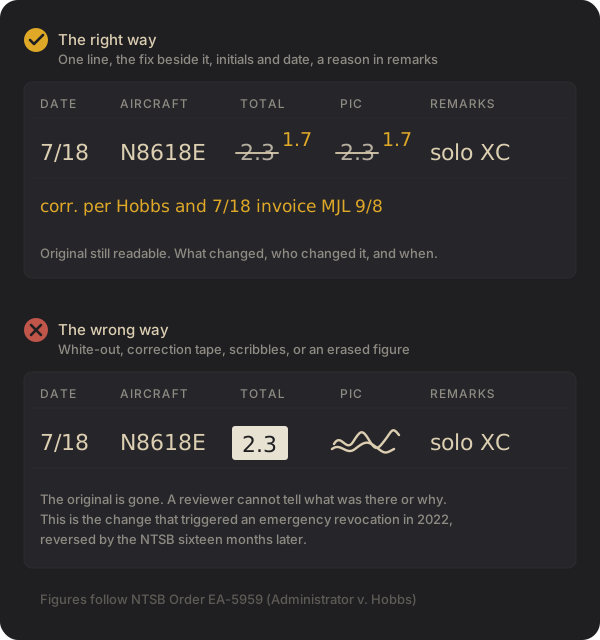
This is not theoretical. In September 2021 a flight instructor in Illinois sat down with his student to fill out the IACRA application the day before a private pilot checkride. Totaling the columns, he found the student was 0.6 hours short of the five hours of solo cross-country time required by 61.109. He believed one flight had been logged from a tachometer instead of a Hobbs meter, so he used Wite-Out correction tape to change a July 18 entry from 1.7 to 2.3 hours, then signed the IACRA attesting the student was ready.
The next morning the examiner opened the logbook, noticed the change, walked to the dispatch office, and pulled the invoice for the July 18 flight. It said 1.7 hours. The examiner declined to conduct the checkride and reported the instructor to the FSDO. On March 9, 2022 the FAA issued an emergency order revoking the instructor's commercial pilot and flight instructor certificates.
The instructor fought it. The administrative law judge eventually found that he had been mistaken about which airplane the student flew, that he had "nothing to gain by the falsification," and that a person intending to deceive "would have made the change less conspicuous." On July 21, 2023, the NTSB affirmed that decision and reversed the revocation. You can read the full order: NTSB Order No. EA-5959, Administrator v. Hobbs.
He was cleared. It took sixteen months, an emergency revocation, a hearing, and an appeal, over a 0.6-hour arithmetic dispute. The correction tape did not cause the error, but it turned an honest mistake into a falsification case, because it destroyed the one thing that would have ended the conversation at the dispatch counter: the original figure and a note saying why it was changed.
Case 1: the error is on the page in front of you
You wrote 2.3 and the Hobbs says 1.7, or you put the night time in the cross-country column. You caught it the same day or within a few pages.
- Draw a single horizontal line through the wrong figure. Thin enough that the original number is still legible. That legibility is the point.
- Write the correct figure beside or above it, in the same column.
- Initial and date the correction. Small, next to the fix. If you are not the person who wrote the original entry (an instructor's entry, for example), see Case 3 below.
- Explain in the remarks column, briefly: "corr. per Hobbs" or "night entered in XC col." One line is enough. This is what a reviewer wants to see, because it answers their question before they ask it.
- Fix the page total and the carried-forward total if the error changed them, the same way: one line, corrected figure, initials.
Do not rewrite the whole line. Do not tear out the page. Do not recopy the page onto a fresh one and discard the original. Every one of those hides the trail, and a hidden trail is what looks like falsification.
This is not folklore. Asked at the hearing in the case above why the white-out caught his eye, the examiner testified that "the common practice is to put a single line through an entry to correct an error and then initial it so that there is a record of what and who made the change" (hearing transcript attached to NTSB Order EA-5959). AOPA's checkride columnist, also a DPE, summarized the same view in Lazy logbook entries (AOPA Flight Training, December 2022): "Simply draw one line through the mistake so it is clear to the reader what adjustment was made. No scribbling. No white-out." The same column asks for black ink only and for totals to be tallied before checkride day.
Case 2: the error is months or years back
You are prepping for an interview and discover that page 31's night column was mis-added by 2.4 hours, and that on page 28 you logged 1.0 of dual received as PIC before you were rated. The running totals on every page since are wrong.
Do not go back and alter thirty pages of carried-forward totals. That is a mess to read and it invites the question of what else was changed. Instead:
- On your current page, under today's date, make one correction entry. Leave the aircraft and route blank, or write "correction."
- In each affected column, enter the adjustment, positive or negative:
+2.4in night,-1.0in PIC,0.0in total time if the flight itself happened and only the category was wrong. - In remarks, state what it is and where the original error is: "Correction to totals: p. 31 night column mis-added; p. 28 dual logged as PIC."
- Carry the corrected totals forward from this line. Every page total after it is now right. Every page before it still shows what you originally wrote, which is exactly the honest record you want.
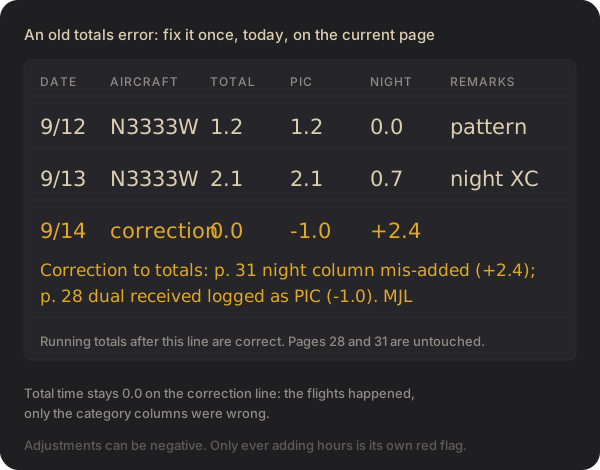
This is the method working airline pilots describe for exactly this situation. In a 2015 Airline Pilot Central thread on fixing logbook errors, the recommended approach was a single correction entry "on your current logbook dated that day" listing "positive or negative adjustments for each affected column," with a remark that these are corrections to the logbook to date and page references where space allows. One pilot who did this reported the corrections "weren't ever mentioned" in his interview and he received a conditional job offer.
A caution on the sign of the adjustment. It is tempting to only fix errors that go your way. If page 31 was mis-added in your favor, the correction is negative, and you make it anyway. A logbook whose corrections only ever add hours is a pattern reviewers notice.
Case 3: the error is in an entry someone else made
Instructor entries and endorsements are not yours to edit. 14 CFR 61.189 requires the instructor to "sign the logbook of each person to whom that instructor has given flight training or ground training" and to keep their own record of endorsements for at least three years (14 CFR 61.189). If a CFI wrote the wrong date, the wrong certificate number, or the wrong duration, the fix is:
- The instructor draws the line, writes the correction, and initials it. Your initials on their entry mean nothing.
- If the instructor is unreachable, leave the entry alone and add a note in your own remarks, or on your current page, explaining the discrepancy and how you know (a receipt, a dispatch record, the instructor's own log).
- For a missing or defective endorsement (wrong wording, no expiration date, not signed), the instructor writes a fresh endorsement using the current sample language in AC 61-65K (November 14, 2025), dated the day it is written, with a note referencing the original training date. Do not backdate it.
Case 4: the wrong number already went onto a form
Sometimes the discovery comes after the total has been sworn to. Two forms matter.
FAA Form 8710-1 / IACRA. Every application you file carries a certification that the statements are true. That form is now squarely inside 3.403 (fraudulent or intentionally false statement on an application) and 3.405 (a material incorrect statement, even without intent). If you find that an 8710 you already filed carried an incorrect total, correct your logbook as above, keep the evidence of the honest error with it, and enter accurate totals on your next application. If the error affected eligibility for the certificate itself (you did not actually have the hours the rating required), that is a conversation to have with an aviation attorney or AOPA's Pilot Protection Services before you have it with anyone else. See also how to fill out FAA Form 8710-1.
Airline applications. Recruiters compare the totals on your application against the logbook page by page, and the mismatch is what sinks candidates, not the correction. Pilots who have been through Part 121 interviews describe the review as "an opportunity to verify the time you said you have on the app," with reviewers looking for gaps, unusual night or IMC ratios, and inconsistencies between claimed totals and the book (Jetcareers, Logbook Review, November 2021). If you find an error after you have applied, update the application if the portal allows it, and bring the corrected logbook and a one-line explanation to the interview. Disclosing a 2.4-hour night correction is a non-event. Being caught with one is not. Our guide to preparing your logbook for an airline interview covers the rest of that review.
What reviewers actually think of corrections
Examiners and recruiters see corrections in nearly every paper logbook. What they read is not the correction itself but what it says about the pilot.
| Reads as honest | Reads as a problem |
|---|---|
| One line, original still readable | White-out, correction tape, erasures |
| Initials and a date on the fix | Anonymous, undated changes |
| A remark explaining why | Silent changes to totals |
| Corrections in both directions | Corrections that only add hours |
| One dated correction entry for an old error | Thirty pages of altered running totals |
| Black ink, consistent hand | A different pen and hand on the numbers only |
The 2015 thread above described the correction entry as "the lowest visibility, most conservative way" to fix an old error, and that is the right instinct: conservative does not mean hidden. It means the smallest, clearest change that makes the record true.
Corrections in an electronic logbook
An electronic logbook removes the mechanics of the strike-through, but not the principle. Electronic records are acceptable to the FAA (the 2008 interpretation quoted above; see also AOPA's Legally Speaking: 'Signing' an e-logbook, January 2012), and Part 3's definition of "document in any format" explicitly covers electronic ones. What the FAA wants is the same "reliable record."
In practice:
- Edit the field, then write the reason in Remarks. The number is fixed instantly and every total recomputes, so a Case 2 correction entry is unnecessary: you fix the original flight and the arithmetic takes care of itself. Keep the habit of explaining why. "Night corrected per Hobbs and sunset table" in the remarks of that flight is your strike-through.
- Keep the source. A photo of the Hobbs, the dispatch sheet, or the paper page the flight came from. KármánLogs keeps your endorsements with the instructor's signature image, and photos of your certificates and documents, inside the logbook for exactly this reason. A photo of the page a corrected flight came from belongs in the same place.
- Signatures and endorsements still need a signature. The Chief Counsel's 2008 letter accepts an instructor "signing whatever the student pilot presents as a logbook, or, alternatively, signing a copy of the training record ledger." Print the page, have it signed, photograph the signed page, and attach it to the flight. See switching from a paper logbook to digital.
- Do not delete and re-enter a flight to hide a change. It is the electronic version of white-out. Edit the existing record.
If you keep both a paper book and an app, correct the paper book with the method above and make the app match. Two records that disagree are worse than one record with a visible correction.
Prevent the next one
Most logbook errors are arithmetic or transcription, and most are avoidable.
- Log from the meter, not from memory, and log the same day. The instructor in the NTSB case was reconstructing a July flight in September.
- Do not round. The 1.3 tach-to-Hobbs multiplication that started that case is a good example of a "correction" that was itself a guess. Log what the Hobbs or the block clock says, and log OUT, OFF, ON, IN when you have them (how OOOI times work).
- Total every page when you finish it, and check the carry-forward against the previous page before starting the next one. An error caught on the same page is a Case 1 fix. The same error caught two years later is a Case 2 fix plus an explanation at an interview.
- Audit once a year against your 8710 records and your 61.57 currency. If the totals on your last application do not match your book, find out why now.
- Back the record up. A photographed page or a synced digital logbook means a correction can always be shown against the original. See where your data is stored and, for the worst case, lost your pilot logbook.
This guide is educational and summarizes the regulations and cases as of the date above. It is not legal advice. If a logbook error touches the eligibility for a certificate you already hold, or an application you already signed, talk to an aviation attorney before you talk to the FAA.
Still need help? Email support@karmanlogs.com.
Sources
- 14 CFR 61.51, Pilot logbooks (Cornell LII, current text)
- 14 CFR 61.189, Flight instructor records
- 14 CFR Part 3, Subpart D, Falsification, Reproduction, Alteration, Omission, or Incorrect Statements (eCFR), including 3.403 and 3.405
- Final rule, 90 FR 42517, September 3, 2025, effective November 3, 2025 (Federal Register)
- ARSA summary of the 2025 falsification rule and the 3.405 revision
- FAA Office of the Chief Counsel, legal interpretation to Daniel Murphy, December 22, 2008 (what a "logbook" can be; electronic records)
- NTSB Order No. EA-5959, Administrator v. Hobbs, served July 21, 2023 (white-out correction, emergency revocation reversed; Hart v. McLucas three-element test)
- AC 61-65K, Certification: Pilots and Flight and Ground Instructors, November 14, 2025
- AOPA Flight Training, Lazy logbook entries, Natalie Bingham Hoover, December 2022
- AOPA, Legally Speaking: 'Signing' an e-logbook, Kathy Yodice, January 6, 2012
- Airline Pilot Central Forums, Fixing Logbook Errors, May 2015
- Jetcareers, Logbook Review, November 2021
Did this answer your question?
If you still need a hand, email us and a real person replies within 24 hours.
Email support