How to fill out a pilot logbook, column by column

Corporate pilot · 10,000+ hours · former airline captain
Updated November 8, 2026
The short answer: every flight you log gets one line, and 14 CFR 61.51 requires that line to show six things: the date, the total flight time, where you departed and arrived, the aircraft's type and identification, the kind of time (solo, pilot in command, second in command, or training received), and the conditions (day or night, actual or simulated instrument). If you received instruction, your instructor signs the entry with a description of the lesson, their certificate number, and its expiration date. Every other column in a paper logbook exists to sort those facts into the totals your next certificate will ask for.
Below: what the rule actually requires, what each column means, a filled-in example flight, how to total a page, and the mistakes an examiner or airline reviewer spots first.
What 14 CFR 61.51 requires in every entry
61.51 is the pilot logbook rule. Paragraph (b) lists what each logged flight or lesson must show, and every item has a home in a standard paper logbook:
| 61.51(b) requires | Where it goes in a paper logbook |
|---|---|
| Date | Date |
| Total flight time or lesson time | Total duration of flight |
| Where the aircraft departed and arrived (or where a simulator lesson took place) | Route of flight: From, To |
| Type and identification of the aircraft or training device | Aircraft make and model, aircraft identification |
| Name of the safety pilot, if 91.109 requires one | Remarks |
| Solo, pilot in command, second in command, training received | Type of piloting time columns |
| Day or night, actual instrument, simulated instrument, night vision goggles | Conditions of flight columns |
Two later paragraphs add to that for specific kinds of time:
- Instrument currency, 61.51(g)(3): the location and type of each instrument approach, plus the safety pilot's name if one was required.
- Training, 61.51(h): the instructor endorses the entry legibly with a description of the training, the length of the lesson, and their signature, certificate number, and certificate expiration date (or recent experience end date).
What 61.51 does not require is a particular book. Paragraph (a) asks you to record the time "in a manner acceptable to the Administrator," and a 2008 FAA Chief Counsel interpretation confirms that a logbook can be a bound book, computer-generated sheets, or any record the FAA can read. Strictly, you only have to log the time you use for a certificate, a rating, a flight review, or recent flight experience. Log every flight anyway: airline applications and insurance forms ask for your complete history, and a gap is harder to explain than an extra line.
The columns, left page to right page
Most US logbooks, including the common Jeppesen and ASA layouts, spread each flight across two facing pages. The left page records what you flew, where, and who signed. The right page records how that time counts. The order varies by brand, but the columns are nearly always these.
Left page: what, where, who
- Date. Most books print the year at the top of the column, so each line only needs month and day.
- Aircraft make and model. The type, such as C172S or PA-28-181. If the difference between a type code, a type rating, and a make and model is fuzzy, see type code vs type rating vs make and model.
- Aircraft identification. The registration, such as N3333W. For a simulator or training device, write the device and its identifier.
- Route of flight, From and To. Airport identifiers. If you landed somewhere in between, record it, in a Via column if your book has one or in remarks if not. A landing more than 50 NM from where you started is what makes a flight a cross-country for most certificates, so that stop needs to be on the page.
- Number of instrument approaches. How many you flew. For currency, also write the type and location of each one in remarks, for example "ILS 9 KFXE, RNAV 30 KBCT." See instrument currency explained for what counts.
- Remarks, procedures, maneuvers. What you did: maneuvers practiced, a hold, the safety pilot's name, "flight review," "checkride." On a dual flight this is also where your instructor describes the lesson and signs.
- Landings, day and night. The number of landings. Night landings only count toward night currency if they were to a full stop between one hour after sunset and one hour before sunrise (61.57(b)), so mark full stops when it matters.
Right page: how the time counts
Every number on the right page is a duration, usually in tenths of an hour (0.1 is 6 minutes). One flight normally shows up in several columns at once: a 2.4-hour solo cross-country is 2.4 in the class column, 2.4 cross-country, 2.4 solo or PIC, and 2.4 total.
- Aircraft category and class. Airplane single-engine land (ASEL), multiengine land (AMEL), and so on. Enter the flight time under the class you flew.
- Night. Time flown between the end of evening civil twilight and the beginning of morning civil twilight, the 14 CFR 1.1 definition. That is a different clock from the one night currency uses; how to log night time explains all three.
- Actual instrument. Only the time you flew solely by reference to instruments in actual instrument conditions (61.51(g)(1)). Filing IFR is not the test: log the part of the flight you spent in the clouds flying by the instruments, not the whole flight plan.
- Simulated instrument (hood). Time under a view-limiting device. Someone has to be watching for traffic, and 61.51(b)(1)(v) wants that safety pilot's name in the entry (91.109 is the rule that requires one).
- Flight simulator or training device. Time in a full flight simulator, flight training device, or aviation training device. It counts toward many requirements, within limits, but it is not flight time, so it stays out of the total duration column.
- Cross-country. Time on flights that meet the cross-country definition you need. For most certificates and ratings that is a flight with a landing more than 50 NM straight-line from the original point of departure (61.1). Log the whole flight, out and back, when it includes that landing. What counts as cross-country time covers the variants.
- As flight instructor. For CFIs: time spent giving instruction. Instructors log the same time as PIC too (61.51(e)(3)).
- Dual received. Time you received training from an authorized instructor. Every line in this column needs the instructor's signature.
- Pilot in command. Time 61.51(e) lets you log as PIC: sole manipulator of the controls of an aircraft you are rated for, sole occupant, or acting PIC where more than one pilot is required. Many books combine it with solo ("PIC, including solo"); others give Solo its own column. A student pilot logs PIC only when flying solo with a solo endorsement. Logging PIC time explained covers the cases that trip people up.
- Second in command. Time as a required second pilot, when the aircraft or the operation requires two.
- Total duration of flight. Your flight time, which 14 CFR 1.1 defines as starting when the aircraft "moves under its own power for the purpose of flight" and ending when it "comes to rest after landing." Hobbs time or block time (OUT to IN) is the usual source. Tach time runs slower than the clock at lower power settings, so it understates flight time.
A filled-in example
Here is a student pilot's dual night cross-country with an instructor: Fort Lauderdale Executive (KFXE) to Vero Beach (KVRB) and back. KVRB is about 88 NM from KFXE, so the flight is a cross-country, and at about 176 NM in total it is the night cross-country "of over 100 nautical miles total distance" that 61.109(a)(2) requires for a private pilot certificate.
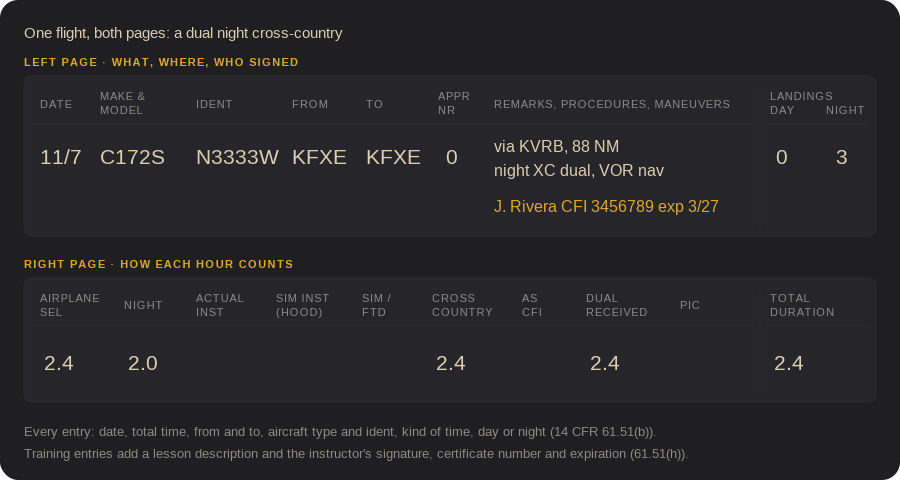
Reading it column by column:
- Left page. Date, C172S, N3333W, from KFXE to KFXE with "via KVRB, 88 NM" in remarks, no approaches, and three night landings to a full stop.
- Remarks. What was taught ("night XC dual, VOR nav"), then the instructor's signature, certificate number, and expiration date, as 61.51(h) requires.
- Right page. 2.4 in Airplane SEL; 2.0 night, because the first 0.4 was flown before the end of civil twilight; 2.4 cross-country; 2.4 dual received; 2.4 total. The PIC column stays empty, because a student logs PIC only when solo.
Totals at the bottom of every page
Each page ends with three rows, filled in for every column:
- Total this page: the sum of the lines above.
- Amount forward: copied from the "total to date" row of the previous page.
- Total to date: the two added together.
Check the carry-forward against the previous page before you start the next one. Most logbook errors are arithmetic, and one caught on the same page is a single strike-through. The same error found two years later, at an interview, is a longer conversation (how to correct a logbook mistake covers both). Many books also have a line at the bottom of the page where you certify the entries are true; sign it when the page is full.
Instructor signatures and endorsements
Your instructor writes two different things in your logbook, and they go in different places.
- Training entries. Every line of dual received gets the instructor's signature under 61.51(h): a description of the training, the length of the lesson, and their signature, certificate number, and certificate expiration date (or recent experience end date). Get it signed before you leave the airport. Chasing months of missing signatures the week before a checkride is a classic scramble.
- Endorsements. Statements that you are authorized or proficient: solo, solo cross-country, the knowledge test, the practical test, a flight review, complex, high-performance, tailwheel. They go in the endorsement pages, usually at the back of the book. The FAA's AC 61-65K has the sample wording most instructors use.
Mistakes examiners and recruiters spot first
- Totals that do not match your 8710. The examiner compares the hours on your application with the book. Reconcile them before you apply (how to fill out FAA Form 8710-1).
- Dual received without a signature. Training time your instructor never signed does not meet 61.51(h), so an examiner can decline to count it toward the requirement it was meant to cover.
- PIC on a student's dual flight. Before your certificate, PIC is solo time only.
- Cross-country on flights that never landed more than 50 NM away. Fine to log under the general definition, but it does not count toward most certificate requirements.
- Night time and night landings mixed up. Night time starts at the end of civil twilight. Night landings for currency start an hour after sunset and must be full stops.
- Approaches without a type and location. "2 approaches" will not support instrument currency on its own.
- White-out or erasures. One line through the error, the fix beside it, your initials, and the date.
- Estimated or rounded times. Log what the Hobbs or the block clock says, the same day, not from memory a week later.
Paper or digital, the columns are the same
A digital pilot logbook records exactly the same 61.51 facts as a paper one; the difference is who does the arithmetic. In KármánLogs you enter your OUT, OFF, ON, and IN times, and the app works out night time and day and night landings from them, totals every column, and builds your 8710 numbers from the whole logbook. Endorsements are kept with the instructor's signature image, and photos of your paper pages sit alongside the flights they came from. If you are moving an existing paper logbook over, switching from a paper logbook to digital explains how to keep the old book as your supporting record. Student pilots can keep theirs free for the first 100 hours.
Questions pilots ask
Do I have to log every flight?
No. 61.51(a) only requires the time you use for a certificate, rating, flight review, or recent flight experience. Most pilots log every flight anyway, because insurance forms, airline applications, and your own currency all depend on the complete record.
Pen or pencil?
61.51 does not say. Use ink: a reviewer worries about records that are easy to change, and pencil is exactly that. If you make a mistake, strike it through once and write the correction beside it with your initials and the date.
Tenths or hours and minutes?
Either works if it is consistent. Tenths of an hour are the US convention, and they add up without minute arithmetic.
Can my instructor and I both log the same flight?
Yes. You log the time as dual received (and as PIC if you are rated in the aircraft and were the sole manipulator of the controls). Your instructor logs the same time as flight instructor and as PIC. Both of you log it as flight time.
Does simulator time count toward total time?
Not toward total flight time. Log it in the simulator or training device column. It still counts toward many certificate and currency requirements, within the limits each rule sets.
What if I lost my logbook?
You can rebuild it from FAA records, rental and club records, and instructor records. See lost your pilot logbook.
This guide is educational and summarizes the regulations as of the date above. Always check the current text of 14 CFR before a checkride, and ask your instructor or examiner when a specific entry is in doubt.
Still need help? Email support@karmanlogs.com.
Sources
- 14 CFR 61.51, Pilot logbooks (eCFR, current text)
- 14 CFR 1.1, Definitions: flight time and night (eCFR)
- 14 CFR 61.1, Applicability and definitions: cross-country time (eCFR)
- 14 CFR 61.57, Recent flight experience: pilot in command (eCFR)
- 14 CFR 61.109, Aeronautical experience: private pilot (eCFR)
- 14 CFR 91.109, Flight instruction; simulated instrument flight (eCFR)
- FAA Office of the Chief Counsel, legal interpretation to Daniel Murphy, December 22, 2008 (what a "logbook" can be)
- AC 61-65K, Certification: Pilots and Flight and Ground Instructors, November 14, 2025 (sample endorsements)
Did this answer your question?
If you still need a hand, email us and a real person replies within 24 hours.
Email support